
Finding and Catching Difficult Dogs
Some animals are more difficult than others, but nearly all dogs can be caught with the right combination of effort, equipment, and patience.


I was fortunate enough to be one of a team of three experts brought to the island of Vieques in Puerto Rico to catch difficult dogs for a TNR project run by the local organization Our Big Fat Caribbean Rescue (OBFCR) in the fall of 2024. One of several assignments was to catch a male and female dog in an inland community that OBFCR had deemed practically un-catchable. These two had already resisted previous capture attempts using a variety of different techniques, but the male still roamed the community, getting into frequent fights, and the female continued to produce litter after litter of puppies. Catching either would be considered a win. To start with, I spent a couple of hours talking to neighbors, learning the layout of the area, and working through the steps I’ll outline below. Difficult dog capture often requires more effort than other animals and may require advanced tools and techniques, so I had come prepared to try anything.
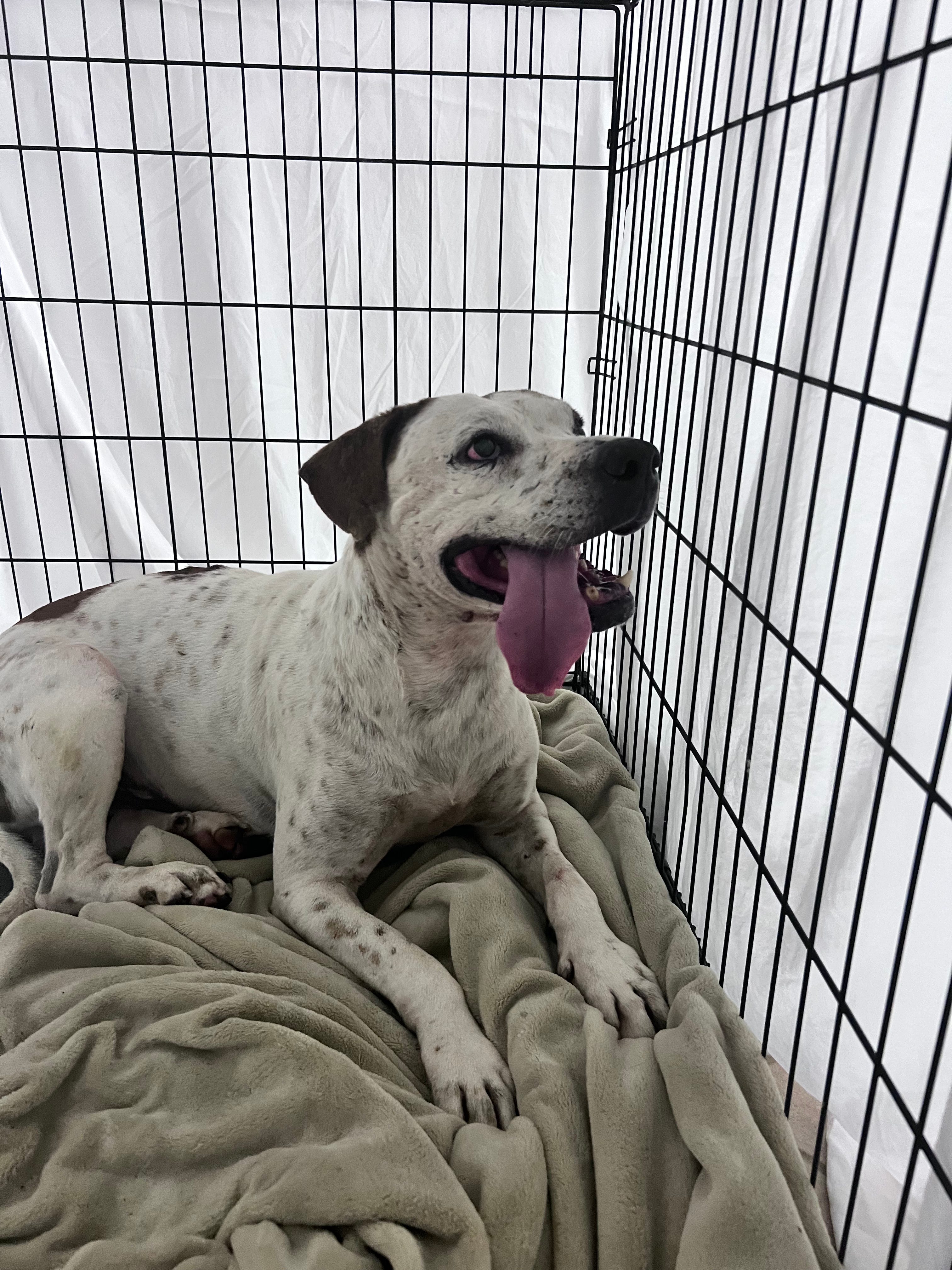
To begin with, what is a “difficult dog”, and why would catching it matter? Some dogs simply will not be caught using the same methods used for the majority of others. They may have had a negative experience with capture before (with equipment or people) or they may be capture resistant because of previous trauma, stress, or simply subjective preference to avoid certain areas, items, or people. So do we need to catch them? That depends on the circumstance. Here is a list of common reasons to target a specific, capture resistant or difficult dog:
The animal is a lost and/or traumatized pet.
The law stipulates that the animal should be caught and managed in some way.
The animal is injured or at risk of injury.
The animal is posing a risk to people or livestock.
The animal is a specific, rather than general, target of population reduction efforts (Trap-Neuter-Return or trap and remove, i.e. the animal is re-productive and is therefore a focus of capture efforts).
The community, government, or other stakeholders want the animal to be captured for some reason and are applying pressure to ensure that it is done.
Catching a target individual requires a process, and if you are serious about the capture, then you need to work the steps. Please note: the first step of capture is not always to approach the animal. If you do that in the wrong way or at the wrong time, you can make capture exponentially more difficult for ourselves. There can be a lot of variables to consider in difficult dog capture, but I’m going to break them down into four basic categories and explain each one. Keep in mind that you can engage colleagues, volunteers, volunteer groups, and community members to support capture efforts. We don’t have to do all of this alone.
Gather information. Before formulating a plan, gather details. Take steps to learn about the animal before making any capture attempts. If someone brought this animal to your attention, learn what you can from them. Drive around the area. I’ve personally found that the best way to learn about an individual animal or group of animals is by walking, running, or cycling around their area without paying any obvious attention. Talk to people in the community, especially kids and older adults. Both tend to have a little more awareness of what is going on in their communities. Kids often explore their neighborhoods thoroughly and can be much more aware of what animals live there. Scour online forums or groups if these are active in the community. Ask people about video doorbell sightings and any forums where animal sightings might be posted (e.g. the “Ring Community”, Nextdoor, and others in the US and some other countries). If you can’t find any or sufficient existing information, then put your effort into developing new sources of information. Put up signs (The Retrievers have great resources), engage businesses or community groups, ask for information on forums, and set up a map where people can publish sightings (Google Maps can be a good option for this). Put up cameras and feeding stations. Cellular cameras have come a long way in the last few years, and they can tell you when an animal is sighted. If you don’t have cameras, try to rough up an area of sand or dirt around your feeding station so that tracks will be visible. This can give you information about species, individuals, and even frequency of visitation. Rake the dirt after you study it to get a clean picture.
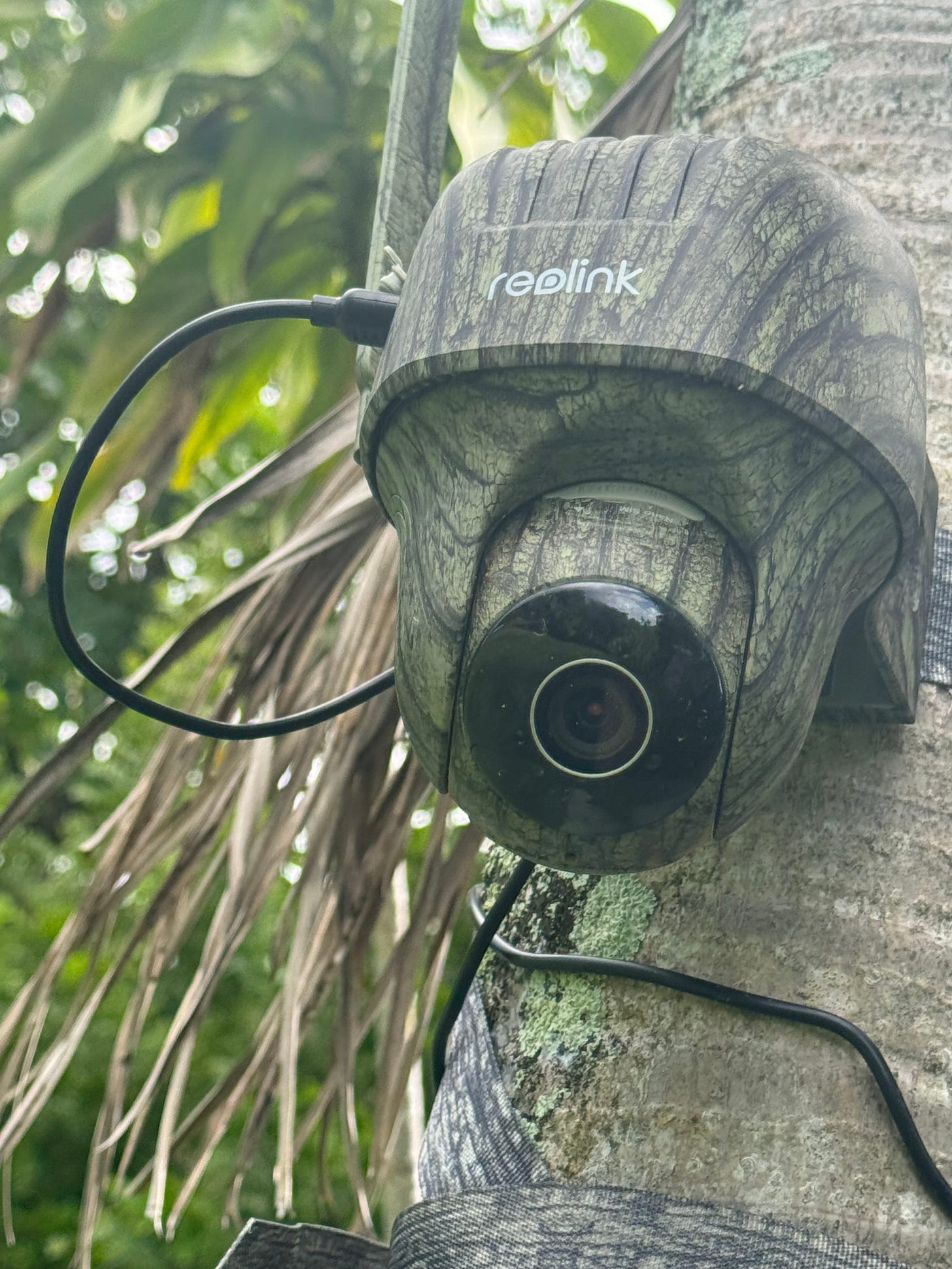
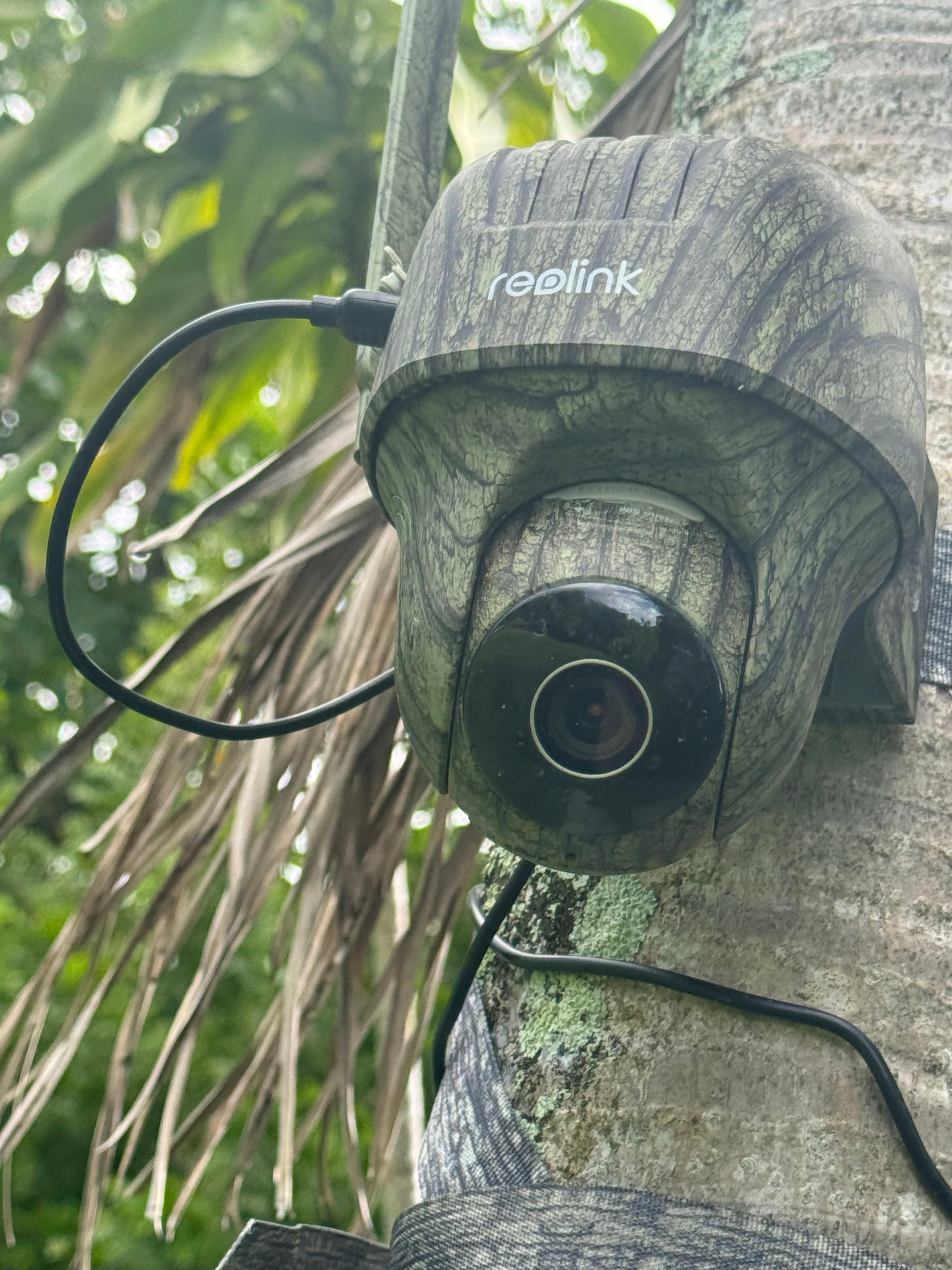
A solar powered, Reolink KEEN, cellular camera set up to monitor a piece of capture equipment. You goal is to learn where they eat, where they sleep, and the boundaries of their territory. The former may end up being at our feeding station(s), but dogs will not always abandon a food source they like and/or trust.
This process may not be easy. Sometimes you will not successfully understand all of their patterns, but as you gather information, you can start to make decisions about how and whether to engage.
Interact with the dog…sometimes. This category can be the most difficult in some ways, and it is certainly the most difficult to explain succinctly. To attempt to summarize: you must have a good understanding of dog behavior in order to know whether and how to make any direct contact with the animal. In essence, the behaviors you are watching for are ‘distance increasing’ and ‘distance decreasing’. However, other than the various forms and signs of aggression, distance increasing behaviors from fearful, traumatized and otherwise less-social animals can be exceptionally subtle. In any interaction, including one executed to perfection by a knowledgeable professional, there is a risk of alerting the dog that we are focused on them, causing a flight response, and their learning what you look like, smell like, and sound like (including vehicles). There are some instances where the dog will approach you immediately, and others where any interaction is only going to harm your ability to catch the dog later. Err on the side of caution. A correct, cautious approach will be to initially avoid looking directly at the dog, avoid speaking to the animal, and to have some good, smelly food as a lure. Try to place some food on the ground up-wind of the dog and walk away, giving them a chance to engage with the scent and the food without being part of the equation yet. Don’t throw the food. If the dog approaches the food, eats it, and engages the scent looking for more, then there is some possibility of relationship building.
There is not one, single way to conduct these initial assessments, but a careful approach will give you more options later. In a perfect world, the dog would tolerate capture by hand or by leash, but that is just not always possible. Don’t overestimate your likability from the dog’s perspective.
Develop and implement a plan. The information that you have gathered should now help you to formulate at least an initial capture plan. Unfortunately, the length of this format is not sufficient to cover every possible option for an advanced capture plan. Start by breaking your capture options down into two categories: Dynamic (net, hand, snappy snare, chemical capture, and flushing animals into containment areas) and Passive (colony/lost dog/missy traps, box traps, collarum traps, containment traps, and drop nets). Dynamic methods can save a great deal of time and effort, but they can also come with a lot of risk. Any failed effort is likely to make capture much more difficult later. In some cases it can become impossible for a period of time or for certain individuals with whom the dog associates with the efforts. Passive methods are less risky and are not always much more time consuming. In some cases, a box trap can be both rapidly and effectively deployed. In other cases, you may have to deploy and redeploy multiple box traps until we get just the right combination of factors (placement, bait, trap size, substrate, time of day, weather conditions, and so on) such that the dog is captured.
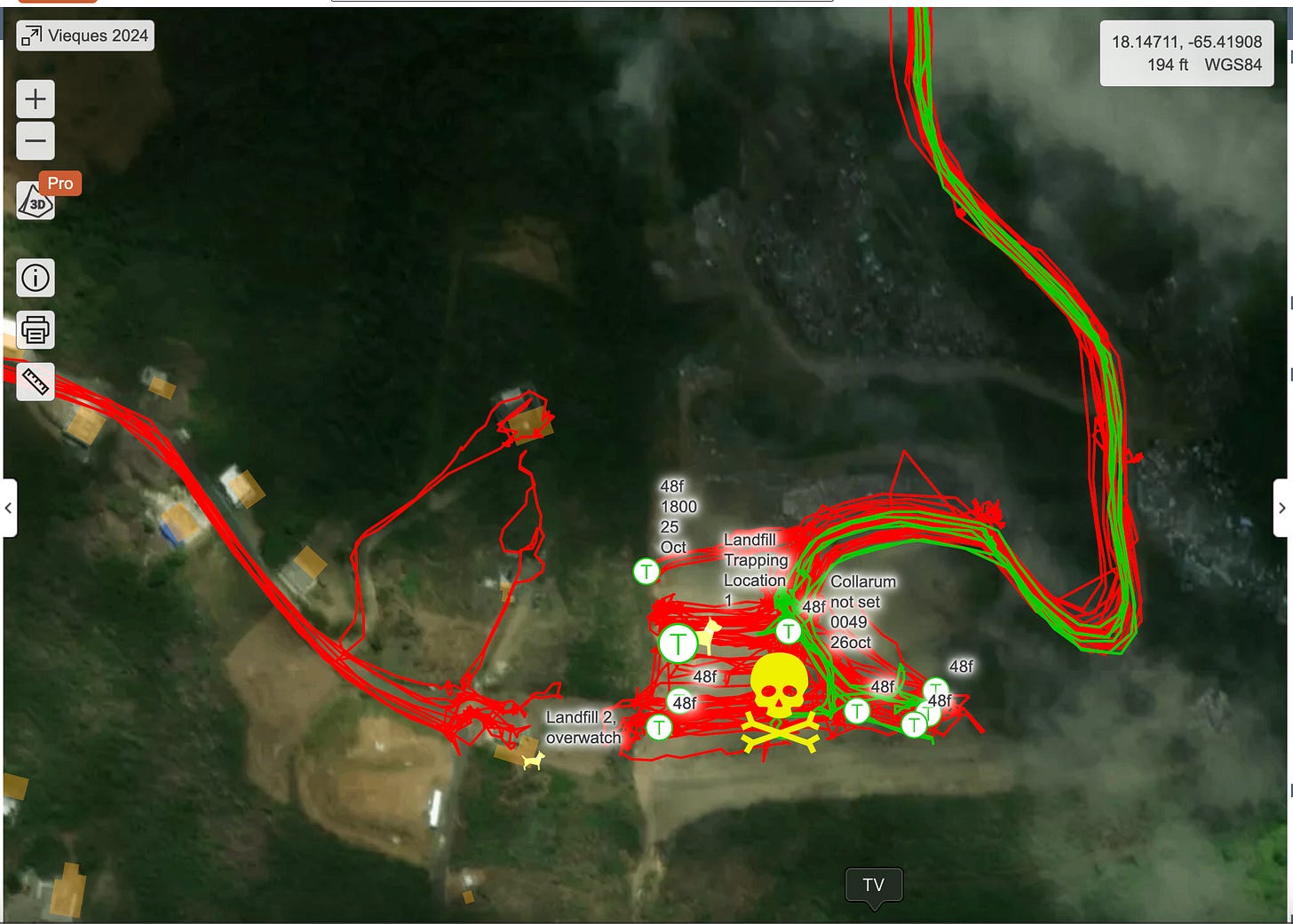
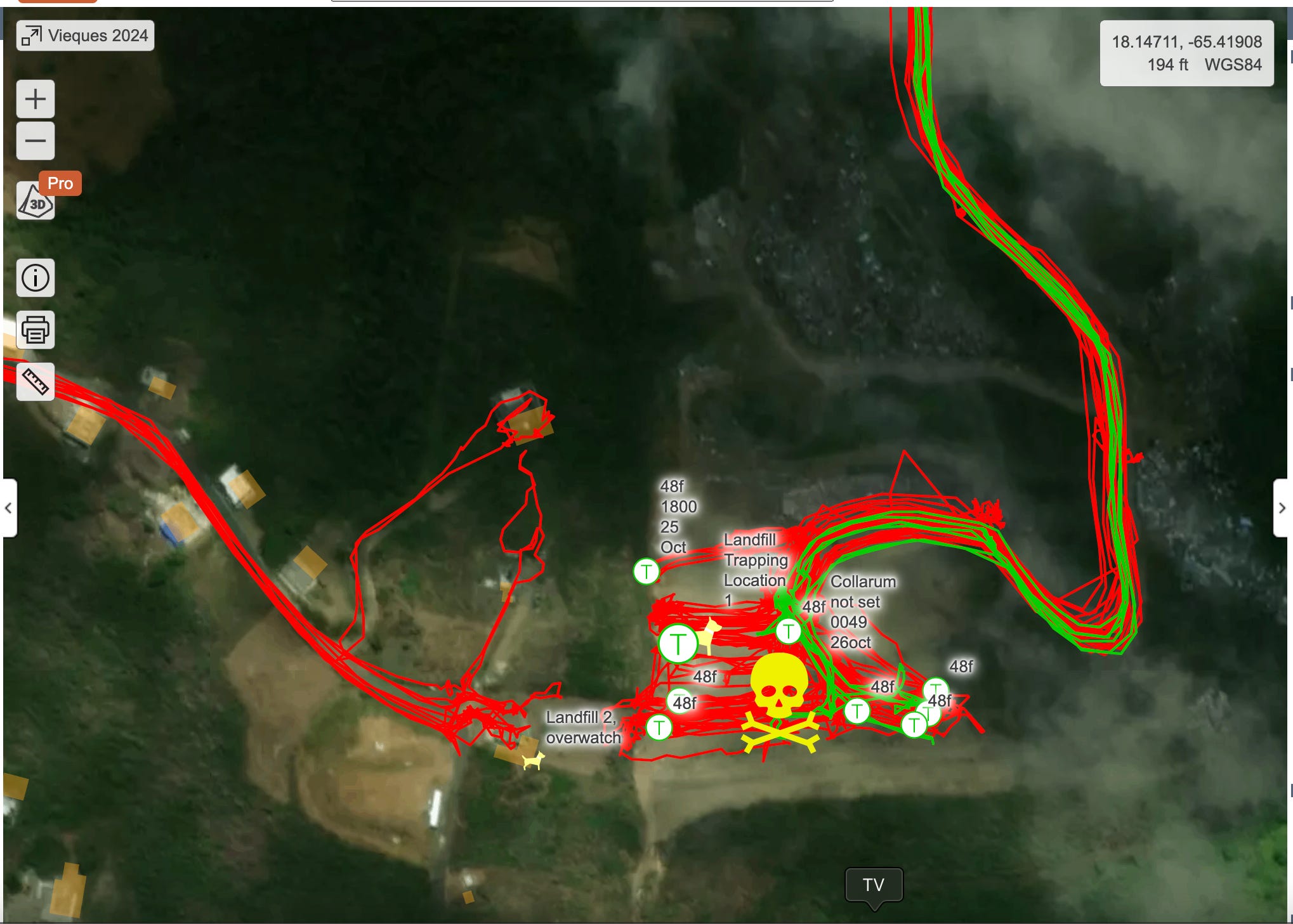
Good mapping information is critical. In this case I’m using CalTopo. Each line represents tracking information of a single team member and shows the amount of effort put into any area. Each sighting is marked with notes, each trap has it’s own marker, and high-risk tools such as collarums are marked with a skull and crossbones to remind us to be hyper vigilant when using them. What you learn about the animal during the information gathering phase will help to inform your strategy going forward. As mentioned before, more than anything, you need to have learned where the animal eats and where they sleep. Feeding stations can help you create the place where the dog eats, but in the absence of your own established site, you need to know where they are getting food.
Dogs do not always behave in ways that are predictable. Unless you are willing and able to put equipment out at random, you need good information to inform placement. If you are limited by any factors to a single capture tool, you want to be pretty sure where to place that tool and be careful in how you do so.
Capture the animal. Difficult animals require you to pay a lot of attention to details. How a capture device looks, feels, and even smells can matter a lot. With very fearful and/or intelligent animals, it’s often necessary to slowly introduce a capture tool. You may want to begin by setting up a feeding station, then setting up the capture tool near the feeding station and slowly bringing the two things together over a medium or even protracted amount of time. Make sure that the tool is not operable until you’re ready. Among the challenges in capture are the risks of catching the wrong individual or species and exposing animals to the elements, biting insects, and ill-intentioned people. Colony traps, containment traps and drop nets in particular require quite a bit of equipment to set up, and may require you to set up the components over time so that the dog can adjust to changes in the environment.
At some point you are going to deploy the capture tool to effect capture. If it feels like there is a whole lot of information missing at this point, that’s because this piece is about the process, not the specific tools. I do plan to publish more articles on specific capture tools over time.
Finally, you need to have a good plan for what you’re going to do after capture is affected. Box traps are simple in this regard, since the trap is portable with the dog inside. If needed, a dog can be easily moved into a transfer cage, or only slightly less easily, into a dog crate for transport. A drop net, collarum, and colony trap all need quick response times, handling skills, tools, and plans. Imagine, in the case of the colony trap, that you do in fact catch an entire colony of 5 or more individuals. Are you ready to enter the cage and get each of the dogs? At the very least, you want to have a good dog net for this. You can also use dog traps, crates, Y-poles, syringe poles or even chemical capture to manage these dogs. You just make sure you’ve thought through these final steps in advance.
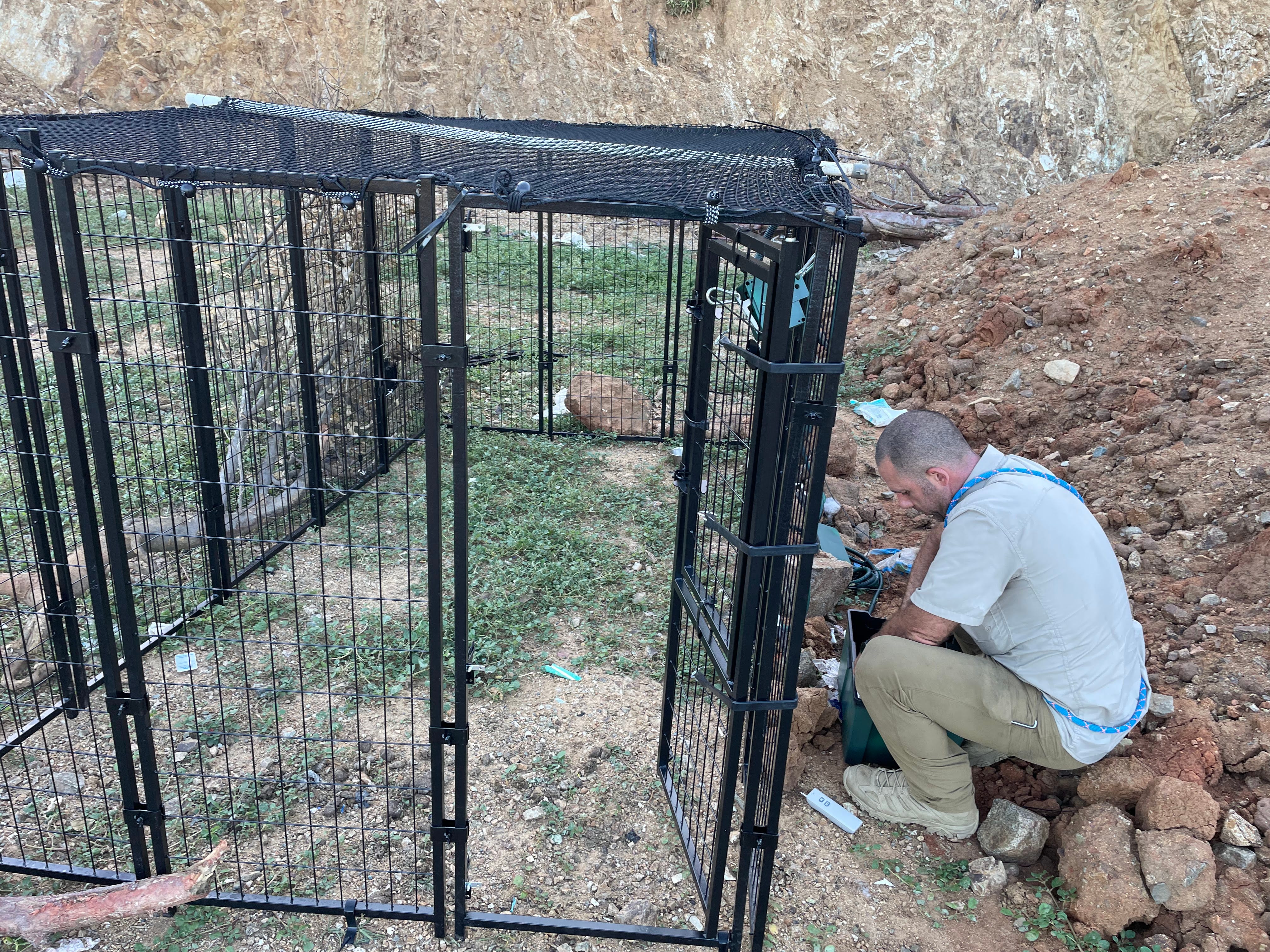
On my difficult dog trip to Vieques, I decided to build what I call a containment trap. The front porch of a house was being used to feed both dogs daily. That porch was covered in security bars, leaving only a door-size opening. Using the modular door, components, and panels of a colony trap, I converted the whole space into a trap. Food was placed in its normal location, but this time just beyond an optical sensor. Furthermore, both a neighbor and myself had remote controls that would trigger the trap from anywhere in visual range. Finally, I positioned a cellular camera with pan-tilt-zoom (PTZ) capability and auto-alerts for motion detection so that I could see inside of the trap, even from my lodging. Within 24 hours of placement, I had caught the male and disrupted the breeding cycle in that little community. A dog that seemed impossible to capture was caught in a relatively short period of time, but mostly because other efforts had already been made, lessons therefore learned, and the right tools were brought to address the problem.
A video walkthrough of the containment trap built to capture the male dog in Vieques. Ignore my first statement…the door should swing outward. Humidity must have made my brain mush.
This article is hardly a complete guide to catching difficult dogs. More than anything, I want to convey that catching difficult dogs is almost always possible. The current tools that exist for our industry give us more options than ever before. Those tools are an important resource, but so is time. You have to work the steps in the process and then match problems to resources. Also keep in mind that if you have people in your sphere that want to help, it may be worth exploring creative ways for them to be usefully engaged. Putting out signs, managing feeding stations and marking sightings on maps are great ways for them to assist.
While there are tremendous financial and other obstacles in many parts of the world, there are also a lot of lower-cost alternatives for capture, such as traps made with wood, buildings and walled spaces turned into traps using strings on doors or gates, and even blow-pipe capture. The thing that money cannot buy is determination. Working through these steps can require a great deal of time, and most dog capture is going to take place between 3pm and 11 pm and between 4am and 10am (temperatures depending). That’s when dogs are likely to be the most active. Take the time to learn dog behavior and the tools and techniques that exist in our industry. From there, you can start to adapt to your own circumstances and come up with plans that can work for you. One of the single most important resources that we all have available to us is a strong network of other animal services professionals globally. Our individual experience contributes to a larger body of knowledge, and together we can help each other do better for animals.
Have questions? Please feel free to comment on this post or email the author at john@humaneinnovations.com